NEW Guide: The Flattening Playbook: Stay Visible, Valuable, and Future-Proof
Why Mid-Career Professionals Are Being Pushed Aside
Grace's Story: The Invisible Shift
Grace sat in yet another Zoom call, silent. Her calendar was packed, but the meeting invites that once marked her as 'essential' had slowed to a trickle. She watched younger colleagues take the lead on projects she used to run, their slides sharp, their energy confident.
Grace had been in middle management for 15 years — respected, steady, dependable. But now she couldn’t shake the nagging thought: Am I being quietly pushed aside?
If this feels familiar, you’re not alone. Thousands of mid-career professionals are experiencing the same shift. Her story mirrors what’s happening in workplaces across industries.

The Numbers Don’t Lie: Middle Management is Shrinking
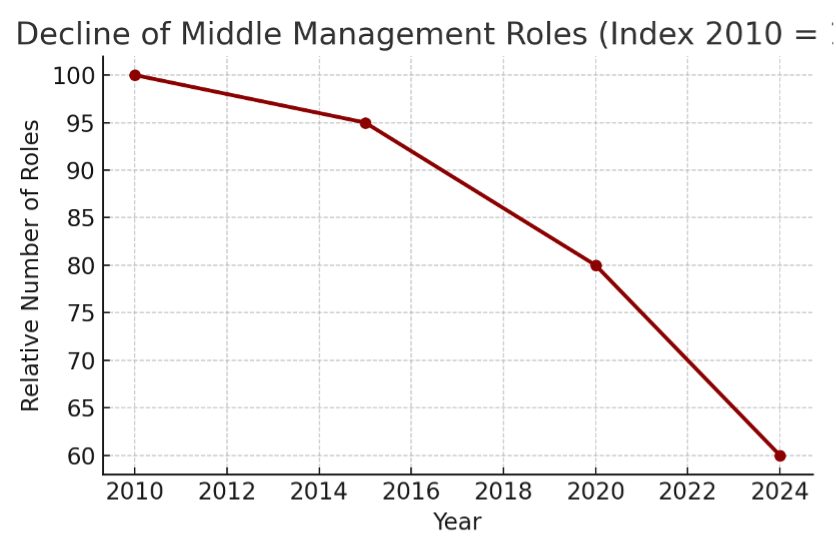
The trends aren’t just anecdotal. Data shows middle management is in decline:
According to a 2023 Korn Ferry study, 58% of global companies reported eliminating or flattening middle management roles.
Harvard Business Review notes that AI-driven automation is replacing at least 20–30% of routine managerial tasks.
AARP research shows nearly 2 in 3 workers over 45 feel sidelined when promotions go to younger employees.
The chart below highlights the overall decline of middle management roles over the last decade.
7 Trends Behind the Shift
Introduction
You didn’t wake up one morning irrelevant. You’re just in a workplace whose rules shifted under your feet.
Mid‑career professionals today (ages 35–55+, with 10+ years of experience) are facing a deeper, more structural push toward invisibility. They’re not failing — the environment is changing.
In this post, we’ll explore why this is happening, how it shows up, and what you can do to reclaim your place.
1. The Great Flattening: The Disappearance of Middle Layers
The most visible trend is what’s being called the 'Great Flattening' — large organizations eliminating middle management layers to cut costs, speed decisions, and reduce complexity.
What that means for mid‑career professionals is that your position becomes 'optional' because leadership assumes fewer layers = leaner overhead.
You're asked to operate with more autonomy and less support, yet still held responsible for results.
Walmart recently cut 1,500 positions and cited plans to reduce layers and 'remove complexity.' In other companies, job openings for middle-management roles have dropped by over 40% since 2022.
2. The Skills & Reskilling Disconnect
Even as AI and automation reshape the work landscape, many organizations invest in reskilling younger employees — leaving mid-career workers behind.
Reskilling programs tend to skip those in mid-career, often focusing on entry-level and early-career staff instead.
This creates a painful gap: your domain experience is still valuable, but unaugmented by newer technical fluency, it becomes discounted.
3. Pressure from Below and Above
Mid-career professionals are squeezed from two sides: from below, younger employees who quickly adopt new tools; and from above, executives expecting more output without extra resources.
You’re asked to be both the hands-on executor and the strategic translator, stretching your bandwidth and making your role unsustainable.
4. Age Bias & Perception Over Performance
Mid-career professionals often face subtler forms of bias — not outright discrimination, but perceptions that younger voices are more adaptable or innovative.
Even in tech-forward firms, there’s a narrative that younger = more agile.
Your experience gives you judgment and pattern recognition, but unless you make it visible, perception wins.
5. Role Erosion: The Shrinking Scope of Management Work
Because hierarchies are flattening, your job description — once broad and strategic — often becomes narrower.
Strategic work is pulled up, tactical execution is pushed down, leaving you with less meaningful scope.
Your role risks becoming hollowed from the inside out.
6. Over-Dependence on Formal Titles
In today’s flatter organizations, many of the old role signals — titles, team headcount, 'manager of managers' — lose weight.
Your influence must come from performance visibility, not hierarchy. If you relied on a title to open doors, that safety net is gone.
7. Invisibility in Meetings & Communications
One of the earliest signals of being sidelined is not receiving invites to key meetings. Even when present, your updates often compete for attention. Long, unfocused reports don’t land.
The people who win in reorganized settings are those who communicate cleanly, strategically, and fast.
What This Means for You
These structural pressures are real — but you don’t have to disappear quietly.
You need a new visibility strategy. One that transforms what you do into what they see.
In future posts, we’ll share 10 specific survival moves and identity strategies to help you push back — not aggressively, but intelligently.
Action Steps
Here are three quick ways to reclaim visibility right now:
Keep updates to three bullet decisions, not three pages.
Ask one forward-looking question in every meeting.
Use AI to draft concise status summaries leaders actually read
Invitation: Assess Your Visibility Risk
Curious where you stand? Take our free Visibility Risk Quiz or download the Stay Relevant Starter Checklist at ReInventMyWork.com to see your current visibility risk and how to shift it.




Reinvent My Work
Use AI to Stay Visible. Stay Valuable. Stay Future-Proof.
© 2025, Gray Roots Society. All Rights Reserved. Privacy Policy
Disclaimer
Gray Roots Society and ReInvent My Work only endorses things we've used or come highly recommended by trusted peers. If you grab anything we mention using our referral links, we may get a small commission. However, there's no extra cost to you. If you would like to learn more, please visit our affilate disclosure page.